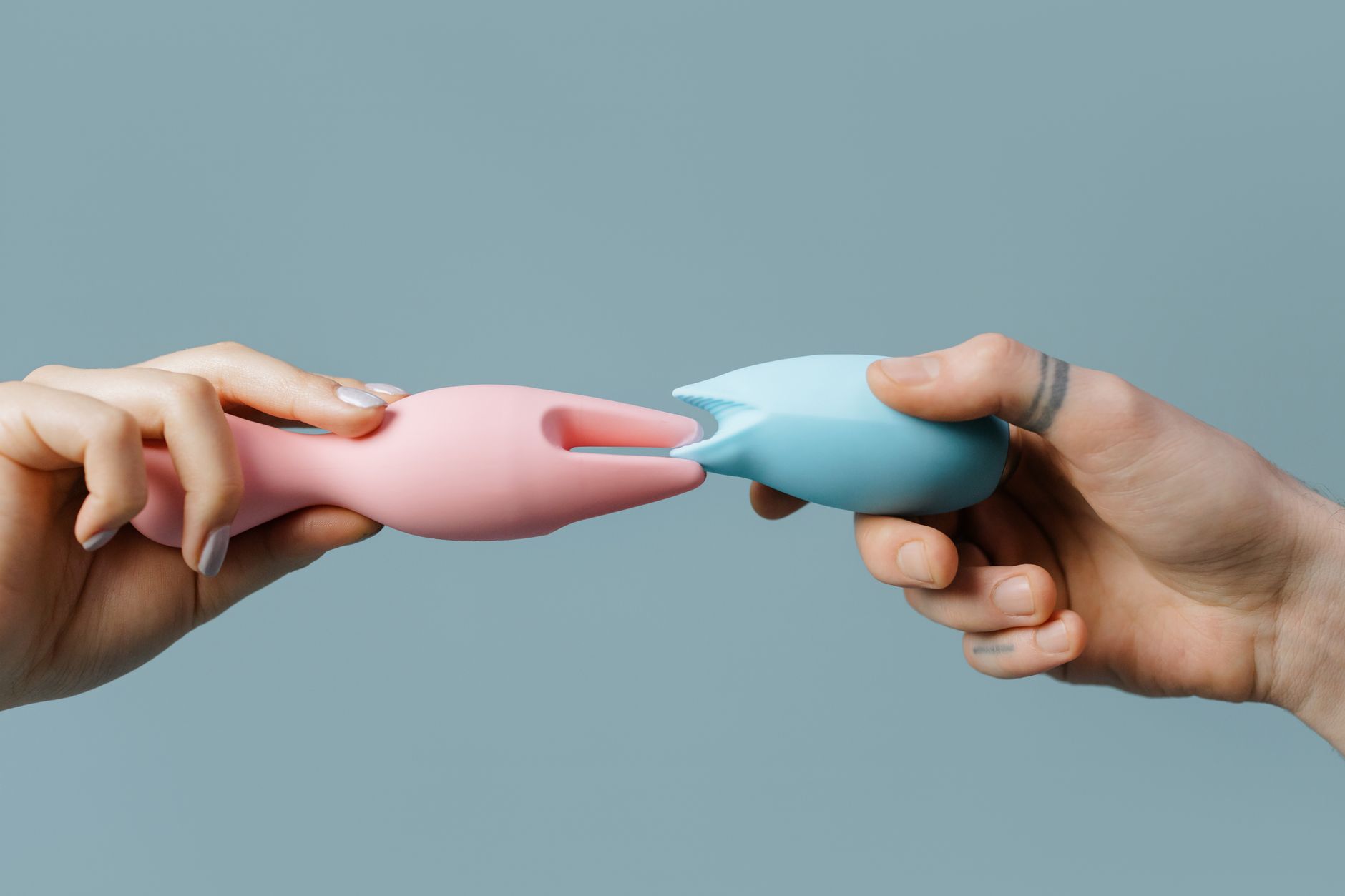
How to Use a Lemon Vibrator for Better Orgasms When Partner Sex Dulls Your Sensation
Partnered intimacy sometimes mutes what solo pleasure feels like. Here's why that happens, and how a lemon vibrator can restore sensation without breaking the connection.
You know how to make yourself come. You know exactly what you need, the rhythm, the pressure, the mental headspace. Then your partner shows up and suddenly none of that translates. It's not about them, not really. Something shifts in your nervous system when another person is involved, and the sensation that felt crystal clear five minutes ago goes fuzzy.
Three things happen physiologically when you're with a partner that don't happen solo. First, cognitive load spikes. You're managing their pleasure, checking in, reading their body language. That mental overhead crowds out the bandwidth you had for pure sensation. Your brain is literally running two programs at once.
Second, arousal builds differently. Partnered arousal often climbs steadily but gently. Solo arousal peaks faster because nothing is moderating the intensity. You might get to 85% arousal with a partner and feel stuck, while solo you'd hit 95% easily.
Third, pressure changes. When someone else is touching you, there's an emotional weight that filters sensation. Not a bad weight, but weight nonetheless. Your nervous system is partly focused on connection and partly on pleasure, and those two things sometimes compete for attention.
The result: sensation feels muted, diffuse, harder to pin down.
A lemon clitoral vibrator like The Lem adds high-frequency, consistent stimulation that cuts through that divided attention. It's not about replacing your partner. It's about adding a signal strong enough that your nervous system can track both the connection and the pleasure simultaneously.
The suction-based design of The Lem works particularly well in partnered scenarios because it creates a distinctive sensation that's separate from your partner's touch. Your nervous system recognizes it as a distinct input, which keeps sensation from blurring into the background.
You're not losing intimacy. You're creating a third point of focus that actually makes the partnership feel more integrated, not less.
Introduce it slowly. Tell your partner beforehand: this isn't a gap in what they provide, it's a tool that helps you stay present and come more reliably when you're together. Most partners appreciate that clarity because they get a win, and so do you.
Start with The Lem on the lowest setting (pattern 1 or 2) while your partner is inside you or stimulating you with their hands. You're not replacing their touch, you're layering on. The lem vibrator adds sensation intensity without requiring your partner to change their movement.
If internal stimulation is involved, they stay focused on depth and rhythm while the lemon clitoral vibrator handles intensity at the source. This actually reduces pressure on your partner because they can move at their own pace without wondering if they're doing it right.
Don't wait until you're already frustrated. Introduce the lemon vibrator early in partnered sessions, when you've both just started. Your nervous system is more open to integrating sensations before arousal narrows your focus.
Some people find that having it available but starting without it works best. You try partnered sex your usual way for 5-10 minutes. If sensation feels stuck or muted, bring The Lem in as a tool, not a rescue. "I want to try something" is enough. No explanation needed.
Other people prefer to start with it already in hand. That signals consent and intention upfront, and removes the awkward pause mid-session. Find what feels like yours.
Here's the trap: using a lemon vibrator during partnered sex sometimes triggers a story that you're not enough for your partner or that they're not enough for you. That's usually not true, but the narrative can feel real in the moment.
The counter is reframing. You're not using a vibrator because something is missing. You're using it because you want your body and mind both in the room during sex. You're choosing presence over performance. That's actually the most connected move you can make.
Talk about it afterward too, briefly. "That felt better" or "I liked that" is enough. You're building a feedback loop that helps both of you understand what works. Most partners, once they see that a lemon vibrator helps you get there reliably, feel relieved. Sex becomes something you both win at, not a mystery you're both trying to solve.
If you've tried introducing a lemon vibrator during partnered sex and sensation still feels muted or numb, it might be worth checking in about what's happening underneath. Sometimes sensation dulls because of medication, hormonal shifts, or nervous system stuff that's not about the partner at all.
That's when reading about how arousal takes longer to build can help you distinguish between normal variation and something that needs attention. A lemon vibrator helps with the physical layer, but it's not magic if the underlying nervous system is offline.
You deserve orgasms that feel good, not just ones that technically happen. If partnered sex has been muting sensation, that's a solvable problem. A lemon sexual toy is one piece of that solution. Communication is another. Patience with your own body is a third.
Start with The Lem on pattern 1. Let your partner touch you however they naturally do. Notice what changes. Your sensation might come back. Your confidence definitely will.
Yes. Position it where your partner can see it or feel it coming, so there's no surprise. Most partners naturally adjust their angle slightly to make room. It takes about 30 seconds of repositioning, then it becomes normal. If your partner is inside you, the vibrator sits externally on the clitoris, so there's no physical conflict. The sensation actually complements penetration rather than competing with it.
Not unless you want it to. Some people use it every time with a partner and love it. Others use it occasionally as a tool when sensation needs a boost. Think of it like running shoes. You don't stop being able to walk without them, but they make the experience better. If you suddenly couldn't access one and needed to rely on partnered sex alone, your body would remember how to do that. The neural pathways don't disappear.
That's a real conversation, and it's worth having before you're mid-session. The insecurity usually comes from a misunderstanding. He might think the vibrator means you're not attracted to him, or that he's not satisfying you. What you're actually saying is: "I want to be fully present with you, and this tool helps me do that." Frame it around your presence, not his performance. Most partners, once they understand that, relax. If insecurity persists, that might point to a deeper intimacy issue worth exploring together.
Yes. If you typically take longer to reach orgasm than your partner does, a lemon vibrator can help you catch up without requiring them to slow down or pause. You're not rushing yourself, but you're also not holding them in an uncomfortable position. It becomes a tool for synchrony rather than sacrifice.
It's worth a conversation first. That doesn't have to be a big deal. "I'd like to try something during sex that I think might help me feel more sensation" is a complete sentence. Most partners appreciate the heads-up rather than the surprise. If you're nervous about how they'll react, remember that wanting to feel good during sex is reasonable. A supportive partner will get that.
Wash it with warm water and mild soap before and after. If you're using it during penetrative sex, make sure hands are clean when you touch it. Some people keep a small cloth nearby to wipe it quickly if they need to pause. It's no more complicated than other toys, and it matters less than you think once you're in the moment.
Partnered sex doesn't have to dull your sensation. Sometimes it does, and sometimes the answer is a lemon vibrator, good communication, and permission to use the tools that help you feel good. Your pleasure matters. Your partner's comfort matters. Both of those things can be true at the same time.